
Are you planning a northern lights hunt and wondering if you should visit Norway or Finland to increase your chances ? Well this article might help you deciding the best destination for your holidays. Norway and Finland are at the northern region of Europe, the two Scandinavian countries. Both Finland & Norway have become an important destinations for travelers to hunt northern lights. But, when you will have to choose one for Aurora happening, it is very important to understand the geographical aspects.
Norway and the northern lights
Geographically suited areas for Aurora occurrence in Norway
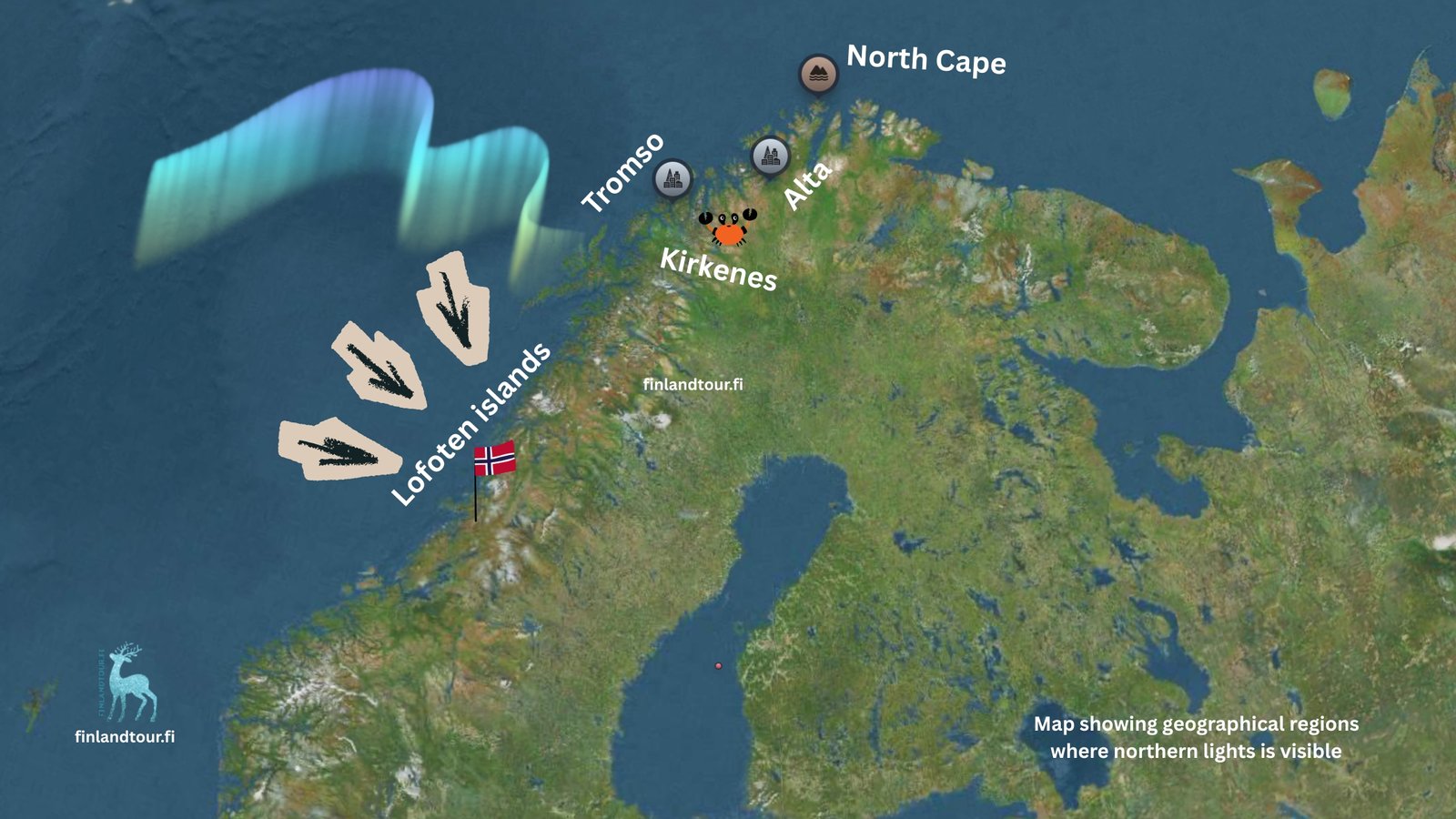
If we understand Norway geographically we will see that the north western region of Norway is more prone to Aurora Happenings. This is mainly because this part of the country lies well above the Arctic Circle, directly under the Aurora Oval — the zone where geomagnetic activity is strongest. Coastal areas here also benefit from relatively milder temperatures due to the Gulf Stream, making it easier for travelers to explore comfortably in winter. Here is the list of destinations in Norway suitable for northern lights visibility:
- Tromso
- Alta
- North Cape region
- Lofoten Islands
- Kirkenes
Best Time Window to witness northern lights in Norway
The Northern Lights season in Norway typically runs from late September to early April, when the country experiences long, dark nights necessary for aurora visibility. Unlike summer months, when the Midnight Sun keeps the sky bright even at midnight, winter provides extended hours of darkness — especially in regions above the Arctic Circle.
The strongest viewing window is between November and February. During these months:
- Nights are at their longest.
- The sun stays very low or does not rise at all in far northern areas.
- Darkness can last 18–24 hours in places like Tromsø and Alta during peak winter.
This extended darkness significantly increases your opportunity window — not necessarily because solar activity is stronger, but because you simply have more hours in which auroras can appear.
In terms of daily timing, the ideal hours to look for the Northern Lights are between 9:00 PM and 1:00 AM. This is statistically when geomagnetic activity tends to peak. However, auroras are unpredictable natural phenomena. They can appear:
- Shortly after sunset (around 6–7 PM in mid-winter)
- In the middle of the night
- Even just before sunrise
Clear skies are just as important as solar activity. Even during peak aurora season, cloud cover can reduce visibility. That’s why many experienced guides monitor:
- Solar wind speed
- KP index (geomagnetic activity scale)
- Local cloud forecasts
For travelers, the key takeaway is this:
The season determines darkness, but the actual sighting depends on the combination of solar activity and clear skies.
For best results, staying at least 3–4 nights in Northern Norway significantly increases your chances of witnessing a strong display.
Weather conditions (Coastal vs Inland Advantage)
In Northern Norway, weather plays a big role in Northern Lights visibility. The difference between coastal and inlandareas is important.
Coastal Areas (Like Tromsø & Lofoten)
- Temperatures are milder because of the Gulf Stream.
- Winters feel less extreme compared to inland Arctic regions.
- However, coastal areas can have more clouds due to ocean moisture.
- Weather changes quickly — clouds can move fast.
Inland Areas (Like Alta, Kirkenes & Narvik)
- Colder temperatures.
- Drier climate.
- Often clearer skies, especially on stable winter nights.
- Less cloud cover compared to coastal regions.
Probability Reality of witnessing northern lights on various factors in Norway

The probability of witnessing the Northern Lights does not depend on just one factor. It is a combination of multiple conditions working together. Some factors matter more than others.
Clear Skies (Most Important)
Even if solar activity is very strong, you will see nothing if the sky is cloudy.Cloud cover is the biggest practical factor. This is why inland areas like Alta sometimes perform better than coastal regions — they often have clearer skies.
No clear sky = No aurora visibility.
Solar Activity (KP Index)
The aurora is caused by solar particles interacting with Earth’s magnetic field.The KP index measures geomagnetic activity on a scale from 0 to 9.
- KP 0–2 → Weak activity (visible mainly in high Arctic)
- KP 3–5 → Moderate activity (good visibility in Northern Norway)
- KP 6+ → Strong aurora, visible further south
Even with clear skies, low solar activity can mean faint auroras.
Location (Latitude Matters)
Being above the Arctic Circle puts you directly under the Aurora Oval — the zone where auroras are most frequent.Destinations like Tromsø, Alta, Kirkenes, and Lofoten are naturally positioned inside this belt, which increases baseline probability.
Further south in Norway = lower natural frequency.
Light Pollution
City lights reduce visibility, especially for weaker auroras.Moving just 20–30 minutes outside a city can dramatically improve viewing quality.Dark surroundings make even moderate auroras appear stronger.
⸻
Length of Stay
This is often underestimated.Auroras are unpredictable. Staying 3–4 nights instead of 1 night significantly increases overall probability because:
- You get multiple weather chances.
- You increase exposure to changing solar conditions.
One night = luck.
Multiple nights = strategy.
The Real Scenario
Think of aurora visibility like a formula:
Clear Sky × Solar Activity × Right Location × Darkness × Time.If any one of the major factors is missing (especially clear skies), visibility drops.
That’s why experienced Arctic guides monitor weather radar and solar forecasts daily and sometimes even drive to different microclimates to find clear patches.
Finland and the northern lights
Geographically suited areas for Aurora occurrence in Finland

If we understand Finland geographically, we will see that the northern region of Finland (Lapland) is more prone to Aurora occurrences. This is because this part of the country lies well above the Arctic Circle and directly beneath the Aurora Oval — the zone where geomagnetic activity is strongest and most frequent.
Unlike Norway’s long coastal belt, Finland’s aurora regions are largely inland. This means the climate is colder and drier, often resulting in clearer skies — an important advantage for Northern Lights visibility. The flat landscapes and vast wilderness areas also provide open horizons and very low light pollution, which significantly improves viewing conditions. Here are the destinations in Finland for better Northern lights visibility:
- Rovaniemi
- Inari/Ivalo
- Levi
- Saariselka
Best Time Window to witness northern lights in Finland
The Northern Lights season in Finland typically runs from late September to early April, when nights are dark enough for aurora visibility. During summer, the Midnight Sun keeps the sky bright, especially in Lapland, making aurora viewing impossible.
Peak Months: November to February
These are the strongest months because:
- Nights are the longest.
- Darkness can last up to 18–22 hours in far northern Lapland.
- Snow-covered landscapes enhance reflection and photography.
Destinations like Rovaniemi, Saariselkä, and Ivalo experience extended polar nights, increasing your opportunity window.
Best Time of Night
The most active aurora hours are generally between:
9:00 PM – 1:00 AM
However, auroras can appear anytime after sunset — sometimes even early evening around 6–7 PM in mid-winter, or just before sunrise.
Weather Advantage in Finland
Because Finnish Lapland is largely inland:
- Skies are often clearer compared to coastal regions.
- The climate is colder but drier.
- Stable high-pressure systems in winter can create multiple clear nights in a row.
This makes Finland one of the most reliable aurora destinations in Europe.
Practical Tip for Travelers
For better chances:
- Stay at least 3–4 nights in Lapland.
- Choose accommodation slightly outside city centers for minimal light pollution.
- Monitor solar activity (KP index) and local cloud forecasts.
In simple terms:
Dark season + Clear skies + Solar activity + Multiple nights = Higher probability of witnessing the Northern Lights in Finland.
Month wise Northern lights visibility trend in Finland

The chart shows a steady increase in Northern Lights visibility from September onward, with a clear surge during December, January, and February.
September – October (Season Begins)
Aurora season starts in late September when nights become properly dark in Lapland. Visibility improves quickly in October as darkness hours increase, but weather conditions can still be variable.
November (Strong Build-Up Phase)
By November:
- Nights are significantly longer.
- Snow begins covering the landscape.
- Aurora activity becomes more frequent.
This month marks the transition into peak season.
December – January – February (Peak Season)
The chart shows the highest probability during these months, and there are clear reasons:
- Maximum DarknessIn Northern Finland, especially in Lapland, daylight hours are extremely short. In some regions, the sun barely rises (polar night conditions).
- Extended Observation WindowWith up to 18–22 hours of darkness, travelers simply have more time each night to witness auroras.
- Snow-Covered LandscapesSnow reflects light, making even moderate auroras appear brighter and more dramatic.
- Stable Winter Weather PatternsInland Finnish Lapland often experiences dry, cold, high-pressure systems that can bring clear skies.
This combination explains the visible surge in the chart.
March (Still Strong)
March remains a very good month:
- Nights are still dark enough.
- Weather can be more stable.
- Slightly longer daylight begins to reduce total viewing hours.
Many photographers actually prefer March due to balanced daylight and aurora probability.
April (Declining Phase)By April:
- Probability naturally declines.
- Nights shorten significantly.
- Darkness window reduces.
The surge in December, January, and February is not necessarily because the sun becomes more active, it is mainly because darkness duration is at its maximum, increasing the opportunity window for aurora sightings.
In simple terms:
More darkness = More chances = Higher observed probability.
How supportive is Solar Activity in Finland
Solar activity is a major supporting factor — but it works together with geography and weather.Finland, especially Lapland, sits directly under the Aurora Oval, which means even moderate solar activity can produce visible auroras.
Why Finland Benefits Strongly from Solar Activity
Because northern Finland is at high latitude:
- Even KP 2–3 (low to moderate geomagnetic activity) can produce visible auroras.
- You don’t always need extreme solar storms.
- Moderate solar wind is often enough for a good display.
This is different from southern Europe, where you need KP 6+ to see anything.
Understanding KP Index Impact in Finland
| KP Level | What It Means in Finnish Lapland |
|---|---|
| KP 0–1 | Faint aurora possible in far north |
| KP 2–3 | Visible aurora likely in Lapland |
| KP 4–5 | Strong, active displays |
| KP 6+ | Bright, dramatic auroras visible across wider Finland |
The Sun follows an approximately 11-year solar cycle:
- During solar maximum → More frequent and stronger auroras.
- During solar minimum → Fewer strong geomagnetic storms.
We are currently in an active solar cycle phase, which increases overall aurora frequency compared to quiet years.
Aurora Solar activity levels for Next Decade
| Time Period | Solar Activity Stage | Aurora Impact |
|---|---|---|
| 2024–2025 | Solar Maximum | High frequency & stronger auroras |
| 2026–2028 | Declining phase | Still active but gradually weaker |
| 2029–2031 | Solar Minimum | Least activity; fewer auroras |
| ~2032–2036 | Rise of Cycle 26 | Activity increasing towards new maximum |
- 2024–2025: Excellent aurora activity due to strong solar conditions.
- 2026–2028: Good chances still exist, especially with clear skies and geomagnetic storms.
- 2029–2031: Aurora activity quieter overall — but strong auroras can still happen around rare solar events.
- 2032 onward: Activity gradually increases again as Solar Cycle 26 strengthens.
Few Finland & Norway Northern lights tour itineraries


Out of Norway & Finland what should you choose for more chances of witnessing Northern lights
If the goal is pure probability of witnessing the Northern Lights, the more decisive choice is:Finland (Lapland Region)
Here’s why — based on the actual factors we discussed:
Clear Sky Probability (Most Important Factor)
Aurora visibility depends first on cloud cover.
- Northern Finland is largely inland with a dry continental climate.
- Inland regions like Saariselkä and Ivalo often experience more stable, clearer winter skies.
- Norway’s coastal areas like Tromsø and Lofoten Islands are influenced by ocean moisture — which increases cloud movement.
Clear sky is the #1 factor.Advantage: Finland
Latitude & Aurora Oval Position
Both Northern Norway and Northern Finland lie under the Aurora Oval.
- Tromsø, Alta, Kirkenes → Excellent latitude.
- Rovaniemi, Saariselkä, Ivalo → Equally strong latitude positioning.
Both are geographically strong.Advantage: Equal
Solar Activity Sensitivity
Because Lapland sits deep under the aurora belt:
- Even KP 2–3 can produce visible auroras.
- Finland performs very well even during moderate solar activity.
Norway performs similarly at comparable latitudes.Advantage: Equal
⸻
Light Pollution
Finland has:
- Extremely low population density.
- Vast forest and wilderness areas.
- Easy access to dark-sky zones near accommodation.
Norway also offers dark areas, but fjord-side settlements can concentrate light.Slight operational advantage.Advantage: Finland
⸻
Weather Mobility
Norway has one strong tactical advantage:
• Guides can sometimes drive between fjords to escape clouds.
But coastal systems can also bring widespread cloud cover.Finland’s inland high-pressure systems can produce multiple consecutive clear nights.Depends on conditions, but statistically stable winter skies inland favor Finland. Advantage: Slightly Finland
Decisive Conclusion – Finland Vs Norway for Northern lights ?
Choose Finnish Lapland If your priority is:
- Highest overall probability
- Stable winter weather
- Clear sky advantage
- Multiple-night strategy
Choose Norway If your priority is:
- Dramatic fjord scenery
- Coastal landscapes with aurora reflections
- Milder winter temperatures
For maximizing your statistical chances of seeing the Northern Lights Finland offers a slightly higher consistency advantage and Norway offers slightly more dramatic scenery.
Nature always has the final say — but from a probability-focused lens, Finland edges ahead for Northern lights viewing compared to Norway.


Comment (0)